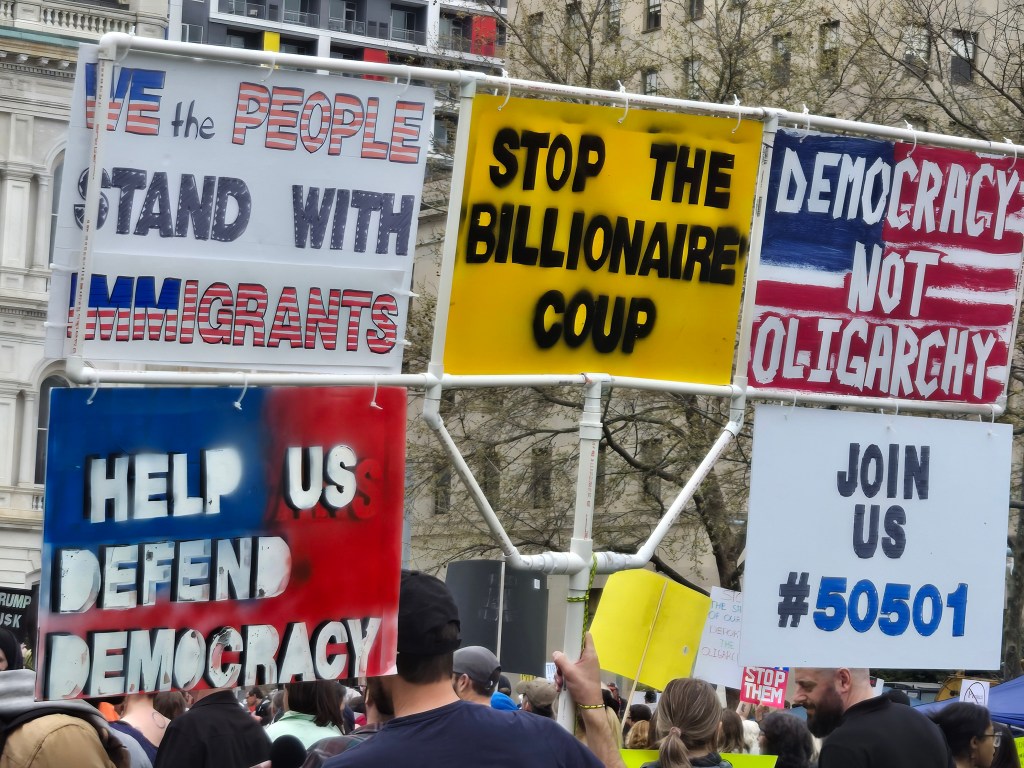
I am a teacher. An American. An older educated white woman. I enjoy the privilege of a pension. I have the luxury of a little more time now. I have experience. I am also angry, and I have been angry for a very long time. Because despite the privilege and the complicity and the hypocrisy that has come with my small corner of the American academy, I know deep down in my bones that while my formal discipline has been philosophy, my desire to speak truth to power is far louder, grittier, and more disquieting than the traditional academy’s need for comfort and reputation can withstand. I remain an unapologetic Marxist, ecofeminist, anti-fascist, whose critique of kleptocratic capitalism as the primary crucible of the climate crisis and its geopolitical impacts has become the focus of my work.
As the United States and Israel continue to rain down war on Gaza, Iran, the West Bank; as plumes of toxic smoke and greenhouse gasses poison air and water, eroding the atmosphere’s capacity to act as the toilet of war profiteers; as regulatory structures crumble under the weight of extractivist greed, the nihilistic toll of capital accumulation on human and nonhuman life becomes buried ever-deeper under the rubble of blathering autocrats like Donald Trump and sycophantic warmongers like Pete Hegseth.
We could not need the critical thinking skills offered by philosophy more than we do right now. Hence, it’s no wonder that philosophy, along with the humanities writ large, has been mostly abandoned as irrelevant by American universities battered by the demands of a white nationalist federal government seeking to erase history and coopted by the neoliberal ambitions of corporate profit venture. Gutting education at every level and replacing it with whitewashed heteropatriarchal indoctrination is essential to the authoritarian aspirations of Project 2025 and a boon to capital’s demand for complacent workers and malleable consumers. Students have become “customers” and professors “facilitators of information” as if “information” and “knowledge” were the same thing. As if the development of critical thinking skills constitutes a form of treason. In one way that’s true. Critical thinking skills pose a mammoth danger to the kleptocratic global order, to settler colonialist violence, to the toxic “manosphere,” to the wealthy beneficiaries of fossil-capital. No wonder that education must be purged; “diversity, equity, and inclusion” are not merely racist and heterosexist dogwhistles to the white supremacist far right, but stand-ins for the critical analyses of the wars, the anthropogenic catastrophes, the theft and toxification of existential resources capital cannot brook. Capitalism is by its very nature kleptocratic–dependent on resource theft. But in the face of dwindling hydrocarbon reserves, the prospect of pandemic, and the rising anger of hungry laborers displaced by technology, the ontological necessity born of capital’s logic of commodification–grow or die–is gravely threatened. That is the point of war on Iran. That is the point of taking over Venezuela’s oil industry. That is the aim of expropriating Greenland, leveling crippling tariffs, insulting Canada as the “51st state,” and the promise to turn Gaza into the “Riviera of the Middle East.” These fascist campaigns are not about democracy; they’re not about the dignity of a people; they’re not about any human good. They’re about money: who has it, who controls access to it, who can be extorted in virtue of it, and who will be crushed under its demand for eternal growth.
But seeing through the thick fog of manifestly false claims about “imminent nuclear threats,” “climate alarmism,” “the dangers of vaccines,” “the radical ANTIFA Left,” “Soros-paid protesters,” and “violent criminal immigrants,” requires a sharp set of critical thinking skills–skills whose education should commence in kindergarten. Alas, American education has fallen short of this vital objective for many decades. In fact, we have cheated our children, especially our children of color, the children of economically struggling families, and our LGBTQ+ children out of the education required for citizenship–out of the education required to be engaged citizens of a democracy. Teachers should be our heroes, but capital doesn’t need heroes; it needs complacent consumers who identify freedom with twenty catsup options at Walmart. A pretty convincing argument can be made that the end of the experiment in American democracy was seeded well before the expansion Westwards. Perhaps a nation whose very origin story is soaked in the blood of slavery and genocide, themselves the product of resource theft advantaged by racism, can never really fulfill the promise of diversity, equity, and inclusion. Or maybe that promise just doesn’t jive with capital’s “grow or die” because racism, misogyny, and (of course) demonizing the immigrant Other offer cheaper and more disposable labor pools.
Higher education is, or at least should be, another shot at developing those analytical skills vital to the life of a democracy. But much of the American academy has either given up the fight for the humanities and/or been corrupted and coopted by the corporate dollars that replace the dwindling support of the state. Along with many of my colleagues and students, I have witnessed in dismay the dismantling of academic departments, the obscene enforcement of anti-DEI policies, the hijack of curricula to “Project 2025’s” authoritarian objectives. But the truth is that we in the humanities are ourselves partly culpable for the end of higher education. Too many of us are way too comfortable in our brittle towers and insular offices; and the rest–armies of adjuncts–too terrified and disposable to speak out. There’s much to say here, but suffice for now: the courage required of at least those among us who have tenure, are at full rank or retired, to stand up for our disciplines, but also to undertake their radical reexamination in light of a world teetering on the edge of ecological catastrophe, torched by war, convulsed by genocide, and awaiting the next pandemic is crucial. Or, possibly, too late. It’s easy to say we must practice the critical thinking skills we try to teach, but it’d be better if we made the effort to exemplify it. We cannot salvage the academy. It’s too dirty, too lost to its purpose. But, whatever name we give to meaningful, self-reflective, probing education: that we can and must do. Wherever, however we can. The assault on education, on literacy, on thinking, on knowledge, art, and science by the morally depraved Trump regime and its kleptocratic benefactors can be challenged; it is the point of this writing.
I have been writing as a feminist, a scholar of Karl Marx, an advocate for nonhuman animals, and a canary in the coal mines of the climate crisis for decades. I have been wildly fortunate. I’m still a teacher. I haven’t been deported, though I wonder about re-entering the country if I travel. And I’m not sure anymore whether that’s just paranoia talking. After all, the argument I’m trying to make–over and over–is that the experiment in American democracy has been irreparably corrupted from its birth by a system of value that can do nothing other than reduce all value, moral, civic, and aesthetic, to the only value capitalism can recognize: commodity exchange. Slavery, colonialism, neoliberalism. Each in its own way, with its own complex histories, geographies, and cultural identities, its own “racist and misogynist “othering” subjugations, its own confrontations with the absurdity of its attempts to justify its barbarism, mirrors each of the others through the blood and shit-smeared prism of capital. For each have in common the single-minded goal of profit; of the power made possible through the accumulation of raw materials, enslaved bodies, land, water, and technology.
Hence, my aim here is three-fold, at least: first to gather my work all in one place, scholarly and pedagogical; second, to continue that work; and lastly, to engage in dialogue, thinking, and outrage with my readers. Come one, come all.
 Rage Against The Kleptocene
Leave a comment